
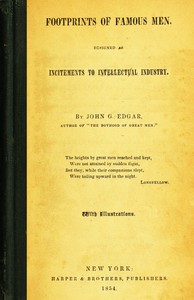
Footprints of Famous Men: Designed as Incitements to Intellectual Industry by Edgar
Okay, let's clear something up first. This isn't a storybook with a single plot. 'Footprints of Famous Men' is a collection of biographical sketches, written in the mid-1800s by John G. Edgar. He gathers a crew of history's biggest achievers—people like Galileo, Sir Walter Raleigh, Samuel Johnson, and James Watt. But Edgar isn't interested in dry, encyclopedic facts. Each chapter is a compact, energetic story focused on how these people became who they were.
The Story
There's no overarching narrative, but there is a consistent thread running through every biography. Edgar picks a moment from each person's life—often their youth—that shows a turning point. You see Galileo's relentless questioning, Johnson grinding through poverty to write his famous dictionary, or Watt tinkering obsessively with a model steam engine. The 'plot' of each story is the same: talent meets hardship, which is then overcome by sheer hard work and intellectual grit. Edgar presents their struggles not as distant legends, but as relatable hurdles. He shows the doubt, the ridicule, the failed experiments, and the moments they almost gave up. Then, he shows how they didn't.
Why You Should Read It
This book surprised me. I expected something stuffy, but it's genuinely energizing. Edgar writes with a conviction that's contagious. He's not just reporting history; he's making an argument. His core idea is simple but powerful: genius isn't a magical gift—it's most often the product of focused effort and an insatiable desire to learn. Reading about these figures in such a direct, cause-and-effect way (this challenge led to that breakthrough) makes their accomplishments feel less like miracles and more like blueprints. It cuts through the romantic haze around famous names and gets to the practical, sweaty work that made them great. In our age of quick fixes and overnight success stories, this 19th-century call to steady, determined effort feels refreshingly radical.
Final Verdict
This book is perfect for anyone feeling intellectually stagnant or in need of a motivational boost without the fluff of modern self-help. It's great for students, lifelong learners, or anyone who enjoys history but wants it served with a clear point. The language is old-fashioned but clear, and each chapter is short enough to digest over a coffee. If you like the idea of a tough-love pep talk from history's greatest minds, give this one a look. Just be prepared—you might feel the urge to put the book down and finally start that project you've been dreaming about.
This book is widely considered to be in the public domain. You do not need permission to reproduce this work.
Linda Moore
10 months agoThe layout of the digital version made it easy to start immediately, the case studies and practical examples provided add immense value. It’s hard to find this much value in a single source these days.
Paul Thompson
4 months agoI stumbled upon this title during my weekend research and the narrative arc keeps the reader engaged while delivering factual content. This adds significant depth to my understanding of the field.
John Rodriguez
5 months agoI found the data interpretation to be highly professional and unbiased.
Michael Perez
1 year agoRight from the opening paragraph, the formatting on mobile devices is surprisingly crisp and clear. I'll be recommending this to my students and colleagues alike.




Susan Martinez
1 year agoOne of the most comprehensive guides I've read this year.